

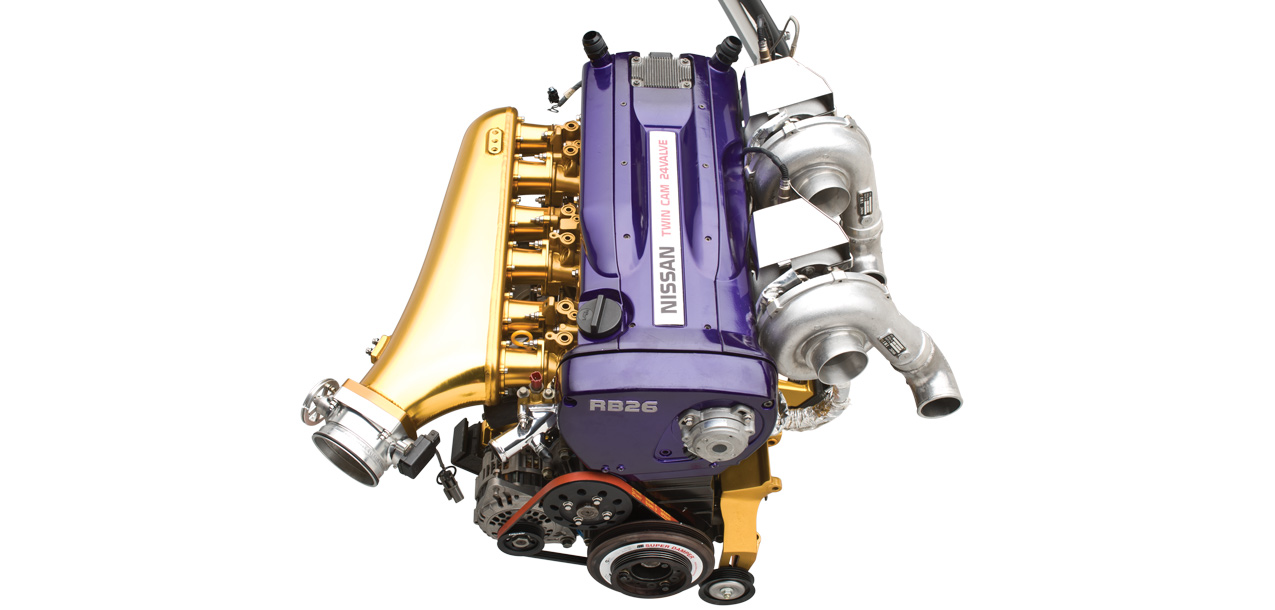
The old saying goes, “There is no replacement for displacement.” However, the majority of DSPORT readers could name more than a few replacements for displacement including higher engine speeds (increased redline), forced induction and nitrous-oxide injection. While it is true that all other factors being equal, more displacement will deliver more torque, how that additional displacement is achieved does factor into the overall performance equation. After exploring how additional displacement can be achieved, let’s take a look at why more displacement may not be the best ingredient to your performance recipe.
Displacement=Bore Area x Stroke Length x # of cylinders
There are only three parameters that establish the displacement on an engine, and only two of those can be altered. While being able to add more cylinders to an engine would increase displacement, engines, in the real world, are designed to have a set number of cylinders without the option of adding more. With that option out the window, only increasing the bore size of the cylinder or the stroke length in the cylinder will affect displacement.
Bigger Bores
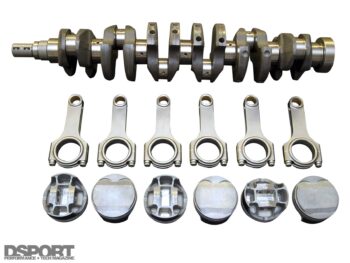
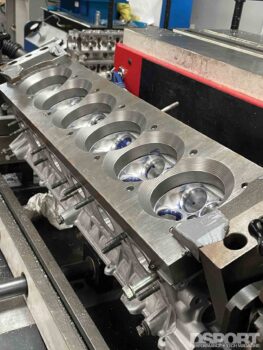
Increasing the bore size is an option in most engines. Cast-iron engine blocks will usually allow for an oversized bore in the 0.5mm to 1.5mm range. Most aluminum blocks will tolerate a 0.5mm oversized bore without sleeving, but sleeving may allow the bore size to be increased by 3mm or more. While increasing the bore size does increase the displacement of the engine, it also reduces the thickness of the cylinder walls. In most cases a 0.5mm oversize won’t cause any issues, but running high cylinder pressures in some engines failure can occur when cylinders are bored 1mm or more oversize. In some cases where sleeves are installed, you can get a larger cylinder bore and a thicker cylinder wall giving you the best of both worlds. At Club DSPORT, we are able to accomplish this with the FA225 shortblocks. These blocks go from a 86 to an 89mm bore size while increasing the thickness of the cast-iron liner thanks to using an LA Sleeve amphibious sleeve.
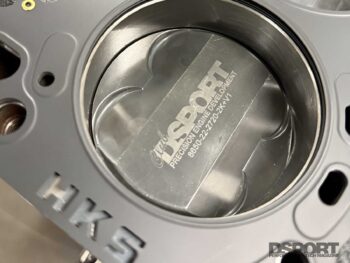
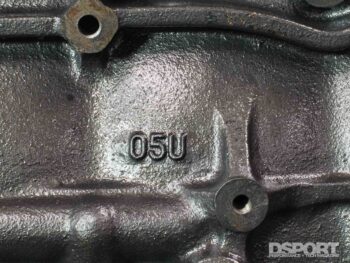
On the RB26, the amount of bore size that can be achieved depends on which RB block is being used and what procedures are being employed. The base engine block (05U) is usually kept to an 86.5mm bore size. If an 05U blocks is sonic tested and offset bored, they can often be bored to a 87.0mm bore size safely. Years ago, when they could be had for under $1,500, N1 blocks were typically punched out to 87.0mm the first time around when building. Now that the price range is $6,500-$9,000 for an N1 block (if you can find it), most tend to start at 86.5mm bore size today. An N1 block can sometimes be OK out to 87.5mm max bore size when sonic tested and properly offset bored. The unicorn RRR blocks were delivered with 87mm bores new and could safely be bored to 87.5mm without an issue. Unfortunately, the cost of one of these blocks if you can find it is going to be in the $15-$20K range used or $30K-$40K new.
The amount of displacement increase that can be achieved by going to a bigger bore on an 86mm engine is 1.17% more with a +0.5mm (86.5mm) bore size or 2.34% more with a +1.00mm (87.0mm) bore size. When the stock RB26 stroke is maintained, you will end up with a 2,613cc engine with an 86.5mm bore or a 2,629cc engine with an 87.0mm bore.
Longer Strokes
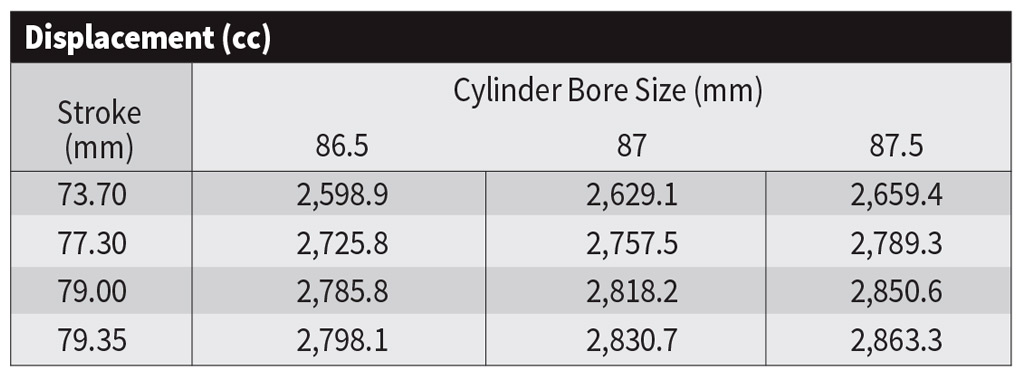
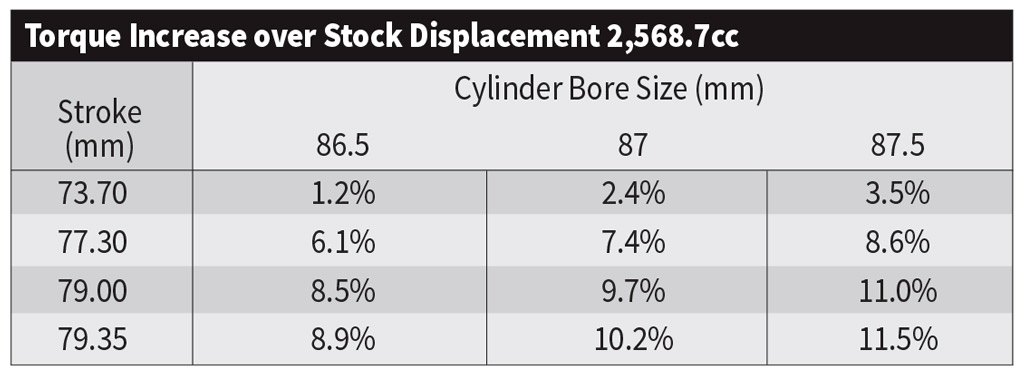
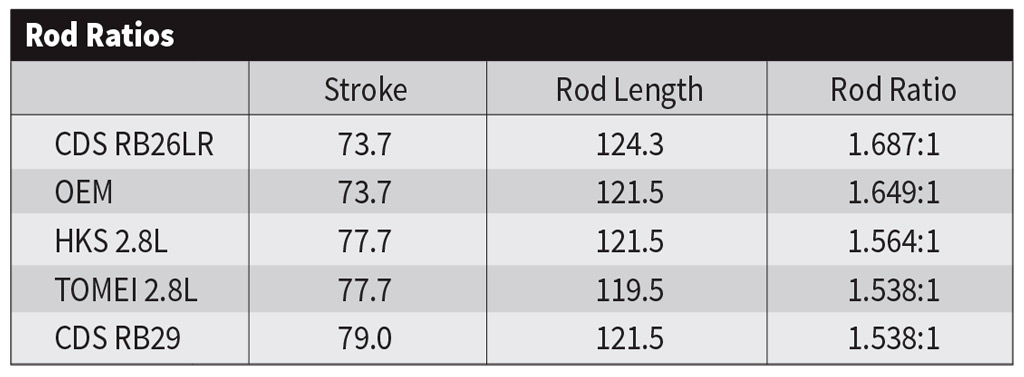
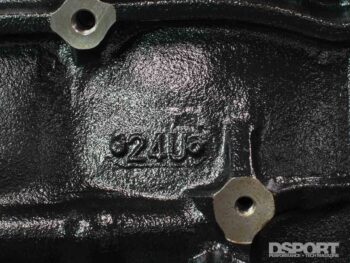
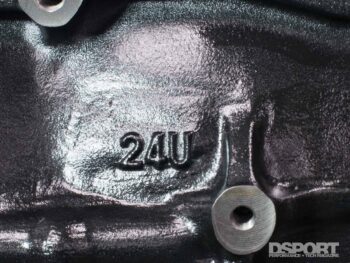
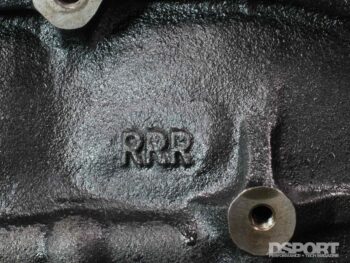
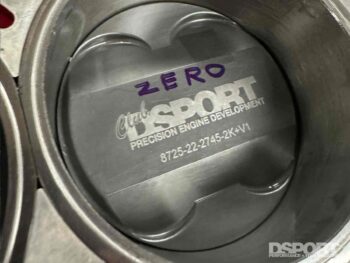
Depending on what RB26 block you are building and what company is doing the machine work, the maximum bore size is going to be set between 86.5 and 87.5mm. The only way to get it right is to sonic check the cylinders and offset bore them in a 4-axis CNC engine block machining center.
What are the Drawbacks?
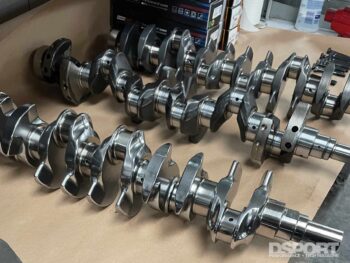
There are two drawbacks to adding stroke to a crankshaft. First, the longer the stroke, the smaller the overlap between the rod and main pins. As a result, all other factors beings equal, the longer the stroke, the weaker the crankshaft. Of course, aftermarket crankshafts can sometimes be made of superior materials and have a better design to counter this drawback. When a crankshaft manufacturer offers multiple strokes of the same crankshaft, the shorter strokes will have superior strength to the longer strokes as they don’t typically do an individual design for each stroke.
The second drawback of adding stroke is that piston speeds are increased and the redline limit of the engine (as set by piston speed) decreases proportionally too. Hence, whatever gains are obtained by adding displacement through a longer stroke crankshaft are generally offset by the reduction in peak engine speeds. For example, if a 73.7mm stroke aftermarket crankshaft delivers a 10,500RPM redline, a 77.7mm stroke engine would have a 9,960RPM redline. The 79.0mm stroke engine would have a 9,785RPM redline while the 79.4mm stroke engine would have a 9,745RPM redline. The bottom line is that if the higher RPM can be supported, a longer stroke engine will not make more peak power than a shorter stroke engine, but it will make less torque due to having less displacement.
Original Plan
On to Something…
The Bottom Line
Ultimately, we hope to showcase all the ultimate replacements for displacement with our next combination. This new combination should have the performance needed to put our Project RH8 R33 GT-R into 7-second territory. There is much more to come so stay tuned.