

This isn’t 1960, but some of the “upgrades” and “solutions” that many “respectable” tuners, engine builders and manufacturers rely upon are the medical equivalents of bloodletting, drilling holes in your skull and tobacco smoke enemas. While not everyone cringes when they hear about a ½-inch head stud upgrade on an engine that had 11mm or 12mm head bolts to begin, if they had a better understanding of the science behind fasteners, they might find some of these upgrades are actually downgrades.
The Objective
As we continue to prove time and time again, bigger isn’t always better. Seeking answers from AI isn’t going to help when most information on the internet is incorrect from the start. In our quest to reduce world ignorance, we’ve decided to provide you with the resources to make intelligent, educated, and above all, correct, decisions about your fastener selection. We will walk you through the basics and build upon this foundation to make you smarter than the majority of the “experts” out there.
Fastener Fundamentals
All modern fasteners owe some credit to the invention of the screw by Archytas of Tarentum (aka “the father of mechanics”). While this occurred 400 years before we had a reason to celebrate Christmas, it took some time before threads became the basis for standardized nuts and bolts. Early on, screws weren’t fasteners; they were tools. Screws were used to make olive oil and grape juice, and it wouldn’t be until the industrial revolution in the 1870s and beyond with US standard and SAE thread standardization when screws and bolts would become more and more popular as fasteners. It would take another 100 years before Automotive Racing Products (ARP) would be established to make high-performance fasteners for the performance aftermarket and racing.
Screw vs. Bolt
Today, most people interchange the terms screw and bolt, and only the most anal-retentive engineers are going to make a stink if you are incorrect. In case you care, a screw fastener will have threads its entire length, and it is designed to go into a threaded hole to fasten. A self-tapping screw will actually create (tap) these threads into softer materials. A bolt, on the other hand, isn’t fully threaded up to its head and it requires a nut to fasten. If you want to live by this convention, factory head bolts should be called head screws. Additionally, an aftermarket head stud would be a considered a screw on the end that goes into the block and a bolt on the end that uses a nut to secure the head. It’s both a screw and a bolt. This is one time where being precisely correct causes more harm than good. At the end of the day, screws and bolts are just fasteners, so let’s stick to that.
Fasteners: Size, Grade and Number
To fix or hold in place is the definition of the verb “to fasten”. Fasteners are the devices that fix or hold things in place. As you might expect, different applications require different sizes and grades of fasteners. Depending on the designs of what pieces are being fastened to each other, the number of fasteners also play a role. The higher the forces acting on the fasteners, the larger in size, higher in grade or more plentiful in number will be the fasteners to get the job done. A pair of low-grade (or even ungraded) small M6 fastener may be all that is needed to secure a plastic cover while a highly stressed fastener, like a head stud, will need to be made of an extremely high-grade material, in a relatively large size and number to keep the cylinder head in place on the engine.
Materials
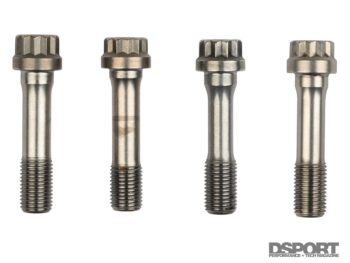
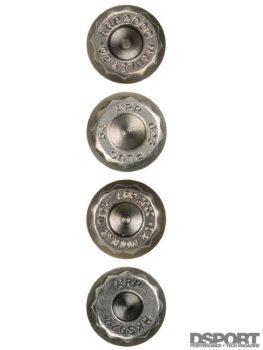
You’ve probably heard of a few of the popular high-performance materials used in high-performance fasteners if you’ve purchased a set of aftermarket connecting rods or some aftermarket head stud or main stud kits. In most cases, these fasteners are likely to be manufactured by ARP. While ARP manufactures fasteners in over 10 different materials on a regular basis, there are five materials that you will likely encounter.
For many years, nearly all ARP head studs, main studs and rod bolts were manufactured from 8740 Chrome Moly steel. Once considered a high-strength steel, 8740 is now only considered a medium-strength steel as superior alloys have been proven over time to deliver better performance. 8740 has a yield strength of 170,000psi (170Kpsi) with an ultimate tensile strength of 190Kpsi. A ½-inch head stud made of 8740 would deliver a clamp load of 18,515 pounds when torqued to 75 percent of its yield strength. In this case, that would require 125 ft-lb of torque when lubricated by ARP Ultra-Torque lube. Looking for an alloy steel that could be heat treated to higher levels of strength, ARP developed ARP2000. This alloy is considered a high-strength steel with a yield strength of 200Kpsi and a tensile strength of 220Kpsi. As a result of its higher tensile strength, an ARP2000 fastener will deliver about 15 percent more clamping load than an equivalent fastener made from 8740 Chrome Moly. A 12mm head stud (smaller in size than a ½-inch stud) made from ARP2000 would deliver a clamp load of 19,425 pounds when torqued to 125 lb-ft (with ARP Lube). This is roughly 5.0 percent more clamping load from a smaller fastener using a superior material. Size does matter, but material matters more.
When 8740 and ARP2000 weren’t enough for the application, ARP offered L19. L19 was the first superior-strength steel that I used back in the 2000s. When ARP2000 head studs couldn’t keep the head gaskets from failing on RB26 engines, we needed something stronger. L19 featured a yield strength of 220Kpsi with a tensile strength of 260Kpsi. This was nearly a 20 percent higher yield strength than ARP2000 or almost 40 percent higher yield strength than 8740 Chrome Moly. Since L19 is an ultra-high strength quench and temper steel (like H11, 300M and Aeromet 100) it’s very prone to stress corrosion. To avoid stress corrosion and hydrogen embrittlement, care must be taken with L19 fasteners to avoid moisture (even the moisture present in the air). L19 fasteners should always be well-oiled at all times, never washed in any water, and handled with latex gloves at all times.
Just how strong is L19? Consider this, an 11mm head stud made from L19 would need to be torqued up to about 110 lb-ft and would deliver 18,600 pounds of clamping force, a few pounds more clamping force than a ½-inch stud made from 8740. Again, material strength proves to be more valuable than fastener size. Today, L19 is still widely used by ARP for rod bolts, head studs and even some main stud applications. It is also the superior-strength steel of choice for custom one-off and short-run orders.
If your nickname is “Pigpen” or you just have trouble treating certain items with special care and finesse, don’t worry—ARP has a superior-strength alloy with the advantages of L19 without the need for special handling. ARP Custom Age 625+ is immune to stress corrosion and hydrogen embrittlement. It has a yield strength between 235 and 255Kpsi with a tensile strength between 260 and 280Kpsi based on the application. At the very least, CA625+ will have the same strength characteristics as L19 without the need for special handling. For certain applications, Custom Age 625+ can be aged to have a tensile strength up to 280Kpsi. Today, ARP offers Custom Age 625+ alloy on its premium head stud kits. Additionally, many rod manufacturers offer ARP Custom Age 625+ alloy rod bolts as an upgrade over ARP2000 in applications where extreme engine speeds or heavy-duty, high-mass pistons and pins are utilized.
Before ARP developed its Custom Age 625+ alloy, the industry relied upon a very expensive high-cobalt alloy know by many names such as MP-35, AMS5844 or ARP3.5. For many years, this was the “go-to” rod bolt material for F1, NASCAR and IndyCar applications. Like ARP’s Custom Age 625+, it is also immune to hydrogen embrittlement and stress corrosion. ARP3.5 has a yield strength in the 220-250Kpsi range with a tensile strength in the 260-280Kpsi range.
Size and Design
Many fasteners are often referred to by their size (for example, a 12mm stud, a ½-inch bolt, etc.). We’ve already learned that the material that makes up the bolt is often more important than the size of the bolt. When it comes to size, not all 12mm bolts or ½-inch studs are the same actual size. An M12x1.25 bolt has a different major and minor thread diameter than a M12x1.50 or M12x1.75 bolt. Usually, the major diameters are pretty close, but the minor diameters can be off by more than 0.5mm in some cases. The M12x1.25 bolt has a minor diameter of 10.619mm while a M12x1.75 bolt has a minor diameter of 10.072mm. So, a finer thread pitch bolt will have a larger cross section than a coarser thread bolt. This difference in cross sectional area will affect how much clamp load it can deliver. All things being equal, a larger bolt will be able to apply more clamping load than a smaller bolt of the same material and design.
Having covered the impact of material and size, it’s also important to consider the “design” of the fastener itself. As a fastener is tightened it will begin to apply a clamping load while simultaneously being put into tension. Up until the bolt reaches its yield strength, it won’t take on any permanent deformation. If it started life at 2.000” in length under no tension, it will remain at 2.000” in length with no tension as long as it was never tightened beyond a point where the yield strength is exceeded. The bolt will still stretch as tension is put on it, even if this is below the yield strength of the bolt.
The difference is that however much it stretches in tension (as long as the yield strength is not exceeded), it will return to its original length when the tension is removed. This is known as elastic deformation. It temporarily moves while under tension but comes back to original size when the tension is removed. If a fastener is put in a situation where it yields and changes in “un-tensioned” length, the bolt is considered to have failed and must be replaced. This is known as plastic deformation. This happens when you mistakenly apply too much tension to a bolt or stud by overtightening. You will feel the amount of effort drop off dramatically as you overtighten and make the fastener fail.
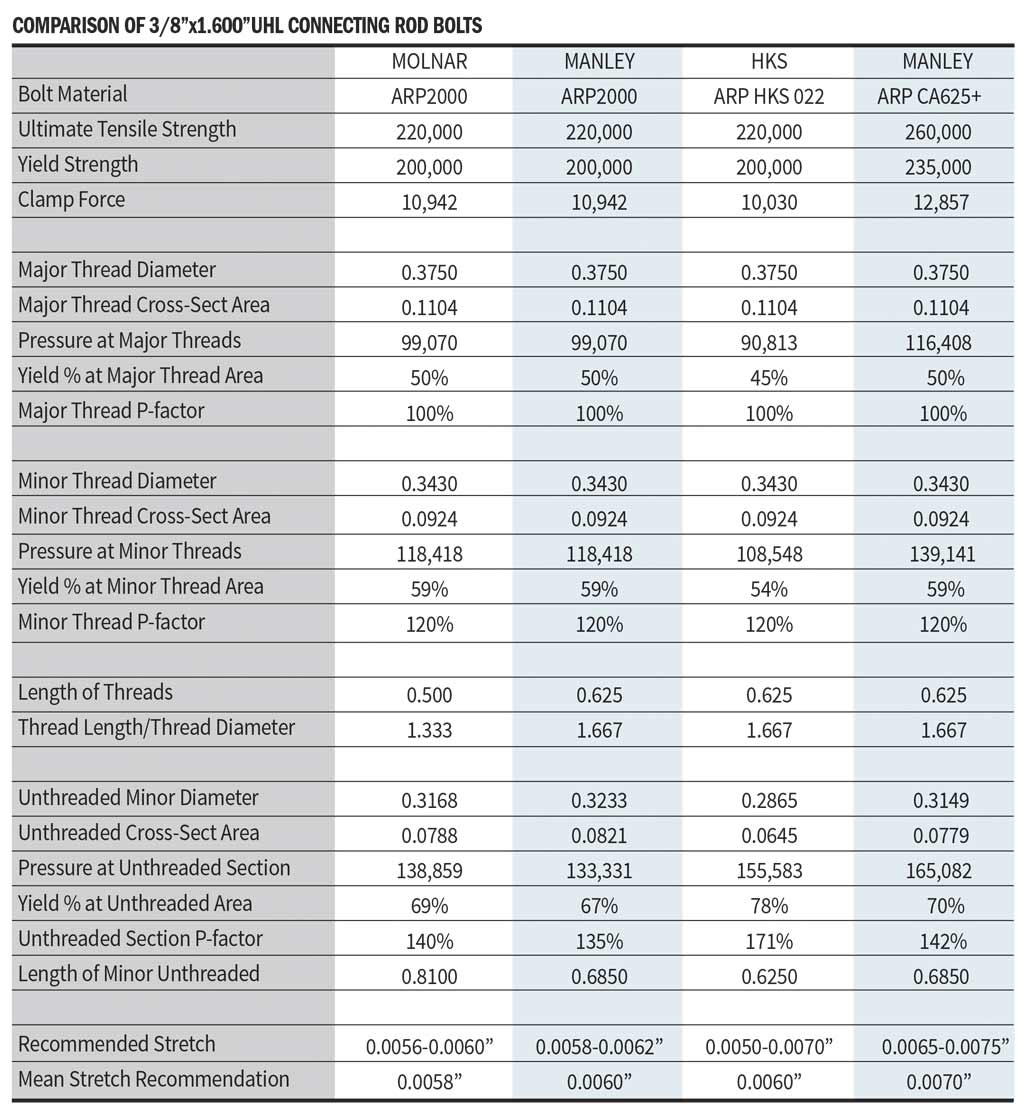
Going back to the fact that high-stress fasteners are usually loaded in such a way that the fastener acts like a spring, the design of the fastener is going to influence how much and where the majority of the elastic deformation (or stretch) takes place. Ideally, the majority of the stretch will take place in the unthreaded portion of a fastener. This requires that the unthreaded portion of the fastener have a smaller cross-sectional area than the minor diameter of the threads. If you look at rod bolts, you will see the most design going into these fasteners as they are the highest stressed fasteners in an engine.
Fastener Installation and Setting
When any fastener is installed, the objective is to achieve a certain amount of clamping force. If the fastener is not “tightened” enough, there will be insufficient clamping force. Insufficient clamping force is one of the may reasons for connecting rod and head gasket failures. If a fastener is installed with excessive clamping force, it will exceed its yield strength either during the installation process or when the engine runs. Once the fastener fails, catastrophic damage can result. Hence, the ideal situation is to get all fasteners to deliver the proper amount of clamping force being “tightened” or set properly. To accomplish this, stretch gauges, torque wrenches and angle-torque wrenches are generally used.
Stretch Is Best
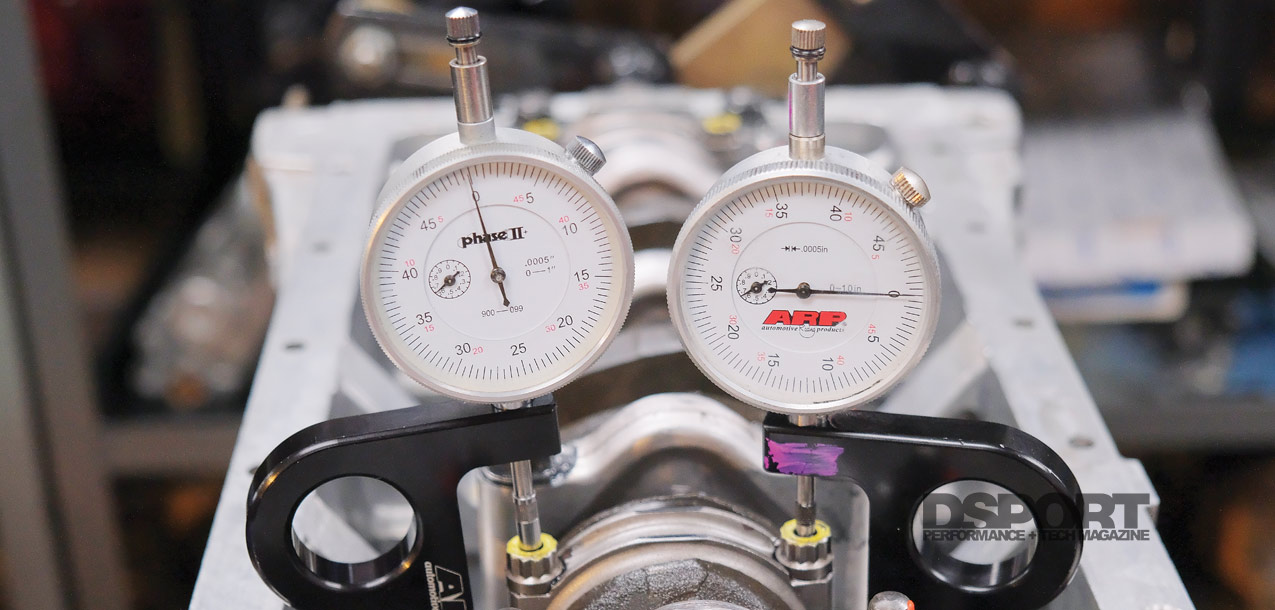
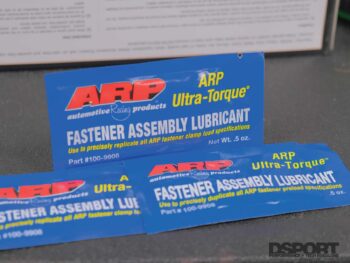
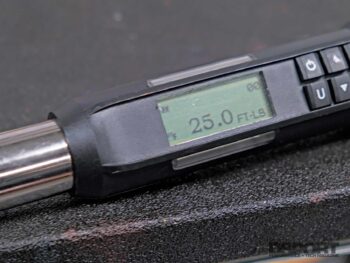
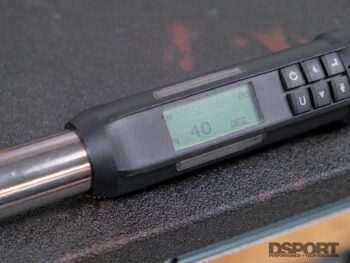
The best way to find out if a fastener is delivering a proper amount of clamping force is to measure the amount of stretch in the fastener. Rod bolts, the most critical fasteners in the engine, should always be checked for proper installation with a stretch gauge. When a fastener is installed properly, it will act much like a spring. You can tighten it and the material stretches, and you can untighten it and the fastener returns to its original length. With rod bolts, there will be a specification provided that specifies the amount of stretch needed to achieve the proper clamping force. You will need a quality stretch gauge to make these measurements. A quality gauge stretch gauge can usually be found for under $200. If you plan on doing a good amount of engine assembly, it helps to have two gauges so both bolts on the connecting rod can be measured at the same time. When using the stretch gauge on rod bolts you can measure the bolts installed but loosened (barely hand tight) for your initial measurement. Be sure to thoroughly lubricate the rod bolt threads, the underhead of the rod bolt and the surface of the rod cap that contacts the rod bolt head. Use a quality lubricant like ARP Ultra-Torque Fastener Assembly Lubricant. We use two stretch gauges so we can measure both rod bolts at the same time. Set up your gauges so that one is for the bolt on the right and one for the bolt on the left. After we zero our gauges on the rested bolts, we torque to just 25 lb-ft on 3/8-inch bolts first. After both bolts are at 25 lb-ft of torque, we switch our torque wrench into angle torque mode at start with 40 degrees of tightening. At this point, we measure the stretch with 40 degrees. Based on how much stretch is not measured we will try an additional 5, 10 or 15 degrees of tightening depending on how far away from the target we are after the first 40 degrees.
Since your torque wrench may also tell you the amount of torque at a set point, you may be tempted to care about those numbers. In fact, DO NOT. If you can measure the stretch properly, just be concerned with getting the proper amount of stretch regardless of what the torque value is at that point. Those imported Chinese connecting rods will often require a lot more torque than you think it should because you are overcoming the excessive friction in the poorly cut threads (tooling not changed often enough to reduce manufacturing cost) and the poor finishes on mating surfaces. If you notice that you are having to reach torque values that seem excessive to get the proper stretch, you should pull everything apart, chase all the threads and make sure the bolts and threads are as clean as possible.
Torque It Up
When you use a proper lubricant, have threads in excellent condition and have mating surfaces that are smooth and defect free, a torque wrench can be used to set the clamping force in fasteners. A torque wrench sets a fasteners load based on the amount of friction read from the torque wrench. The lower the final torque value for the fastener, the more consistent the amount of clamping load will be. However, at high final torque settings where multiple fasteners are present (like the head studs on an engine), the more likely there is to be a big variance in the actual clamping load on each fastener. The first time a fastener is “torqued” up to a specific value, it will generally have the lowest amount of clamping force. After tightening and loosening the fastener several times, it will become more consistent in the end amount of clamping force it delivers. According to ARP, it is not uncommon to see clamp load scatter on cylinder head studs in the range of 4,000 to 8,000 pounds of force difference between the first and tenth time the fastener is tightened and loosened.
If you are ever using a torque wrench and the torque value stops increasing as you tighten the bolt further. STOP! There is something wrong. The bolt may be too long for a hole or the grade of bolt is not good enough for the amount of torque you are applying.
Low Torque to Start, Right Angles to Finish
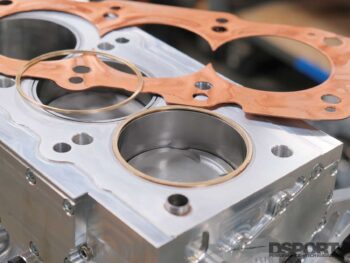
Since head studs can’t be measured for stretch, the next best way to get consistent clamping force is to use a combination procedure like the one we use at Club DSPORT on all our engine builds. A torque wrench delivers very consistent clamping forces at low torque levels so we use that to our advantage. After properly prepping the stud, washer, and nut, we torque all the head studs to 20lb-ft, then 30lb-ft and finally 40lb-ft twice. On an ARP CA625+ head stud, that is going to be about 25-35% of the final torque value. We then switch our torque wrench into angle torque mode. We then begin with about 30 or 40 (depending on the application) degrees of angle to the fastener and we record all the torque values at that point. We repeat and may adjust the amount of angle depending on our results from the previous round. The end goal is to use an equal amount of angle on all the fasteners to get an average final torque on the fasteners to be at ARP’s recommended target. Depending on the application, we may finish this only to loosen it again and start over to overcome any errors that may arise from the head gaskets’ first setting.
Torque-to-Yield
Some OEMs use fasteners that are for single-use only. These are commonly known as torque-to-yield fasteners. Never re-use one of these fasteners as they will not be able to deliver the desired clamping load after its initial use.
The Bottom Line
You can’t win a race, if you can’t finish a race. To finish a race, you need your fasteners to do their job. Selecting the right fasteners for the application and following the proper installation and setting methods will increase your chances of keeping all the parts of your engine together.