

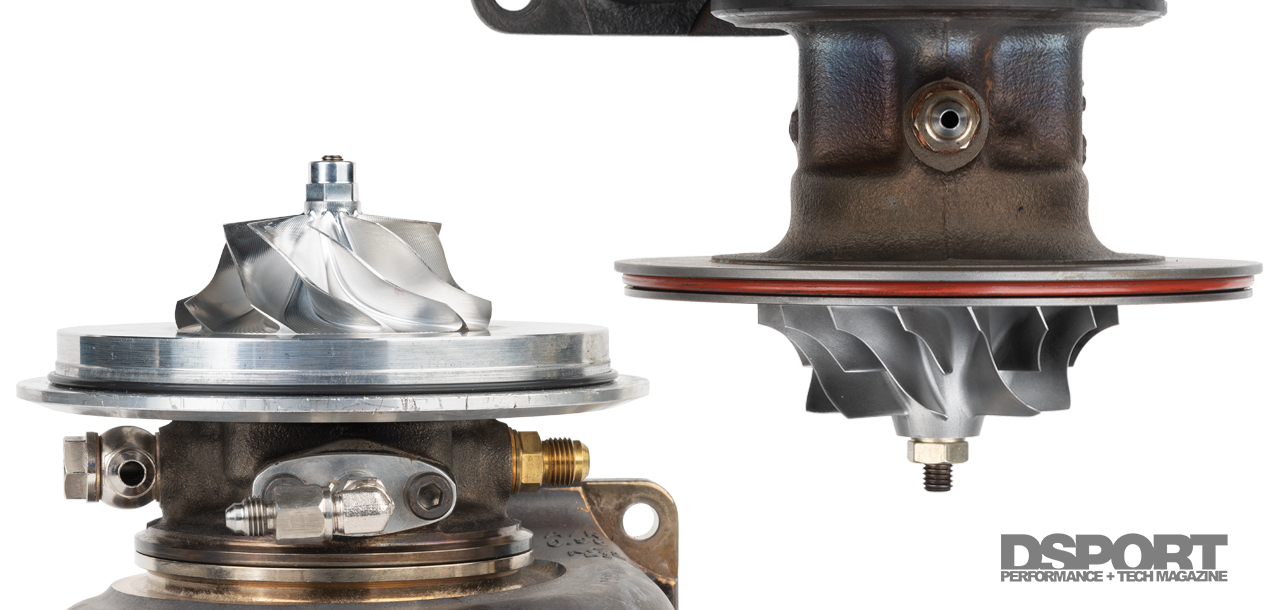
“Bigger is better.” In some cases, this statement can prove to be true, especially when comparisons are made between components of similar technology. Babe Ruth found that a bigger and heavier bat could make a ball travel farther. His bat choice for the biggest and heaviest bats influenced other power hitters. However, today’s biggest wood bat can’t drive a baseball as far as an aluminum bat that is smaller and lighter in size. The reason is simple. Technology trumps Bigger. To illustrate Technology’s advantage over Bigger, we decided to compare one of today’s most-technologically-advanced performance turbochargers against one of the most popular turbochargers over the past three decades.
Fighting out of the Technology corner, weighing in with a 62mm compressor, will be the Garrett G-series G40-900 turbo. In the Bigger corner, packing a 66mm compressor, it’s the MHI T78-33D turbo. Both turbos will be tested on the same engine, with the same fuel and at the same boost levels to determine differences in power output, torque output and boost response. Let’s get ready to dyno!
MHI T78-33D GReddy SPEC
Mitsubishi Heavy Industries (MHI) has been a major manufacturer in the turbocharger market since 1980. During the 1990s and up until the early 2010s, the highest-performance variants of the MHI turbos could only be sourced through GReddy (TRUST Performance in Japan). During this period, each of the Japan’s top full-line tuning companies had a relationship with each of the major turbocharger manufacturers. In addition to the GReddy/MHI relationship, HKS worked with Garrett’s Japan division, A’PEX Integration collaborated with IHI, and Blitz worked with KKK (purchase by BorgWarner in 1997).
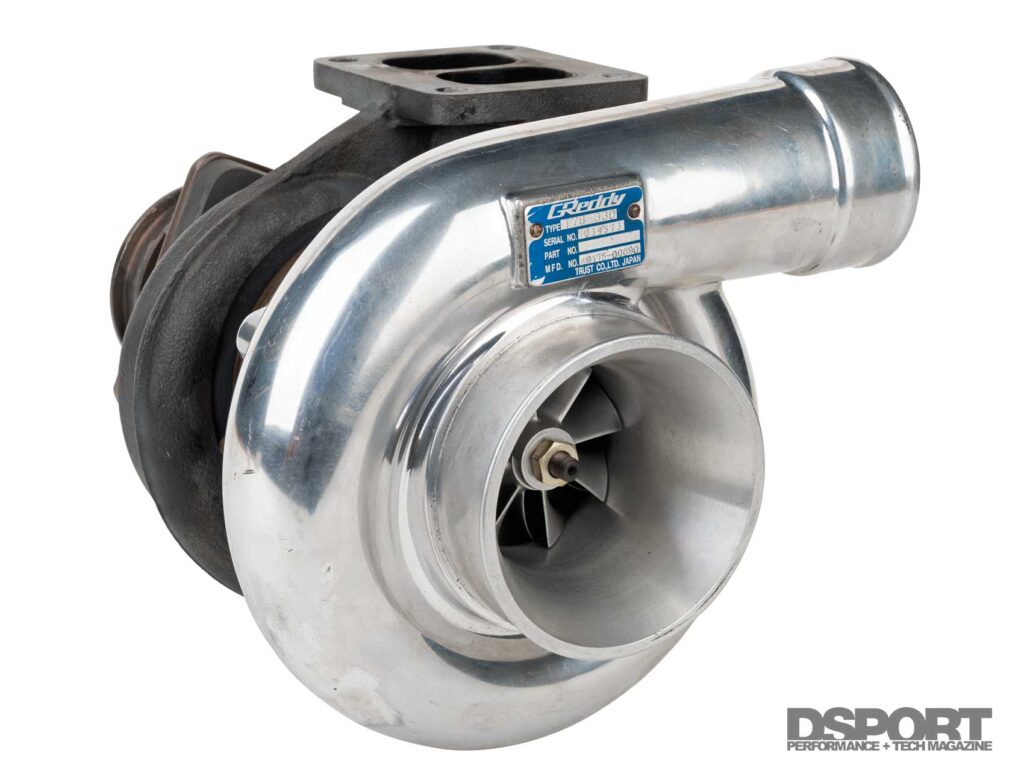
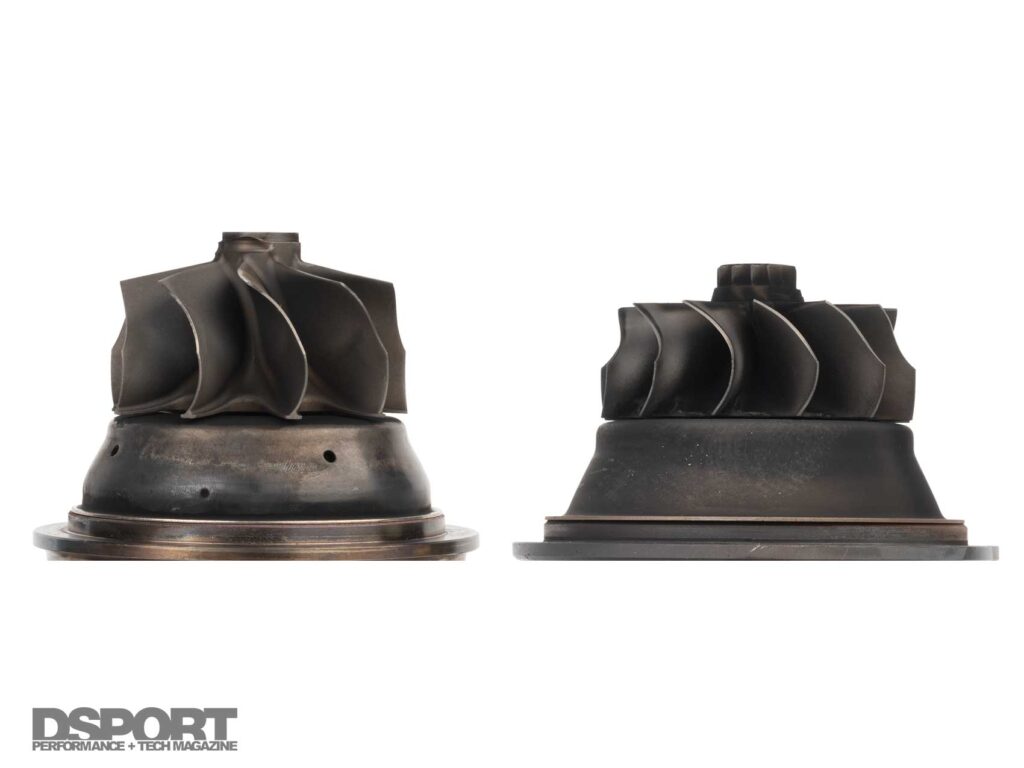
The GReddy/MHI T78-33D turbocharger has spent the past 30 years in Japan as the most popular single turbocharger for applications seeking 600-720 horsepower. In fact, many turbo kits offered by Trust (GReddy’s Parent Company in Japan) still use this same turbo today. This turbocharger features a durable journal bearing center section (with no water cooling) making installation easier. On the hot side, a 77-trim TD07 turbine wheel (74mm inducer/65mm exducer) is fitted into a divided inlet, twin-scroll housing with a choke area of 17cm2 (equivalent A/R of 0.96) that features a divided-T4 footprint. On the cold side, the compressor housing features a 100mm inlet and 70mm outlet.
The “33D” variant of the T78 hybrid turbo uses a 33D-series TD08 compressor wheel that features a 53.5-trim (65.8mm inducer/90mm exducer). The “33” designation refers to the amount of corrected airflow (in kilograms per second multiplied by 100) at 1 bar of boost pressure at peak efficiency. This would be about 44lbs/min or the equivalent of about 440 horsepower. This isn’t the peak horsepower limit of the turbocharger, but rather just a reference point to show where the peak efficiency is of a particular wheel at a given 1 bar (14.5psi) of boost pressure. The “D” indicates that it is a split 8-blade design for medium pressure ratios. While we couldn’t locate a compressor map for the 33D compressor, we did find one for the 29D. The 29D compressor map showed a very good peak efficiency although the size of the high-efficiency islands on the map were much smaller than the G-series. What was very interesting was that the Garrett G40-900 also had a similar peak efficiency flow of about 45lb/min when looking at its peak efficiency at the same boost level.
Garrett Motion G40-900
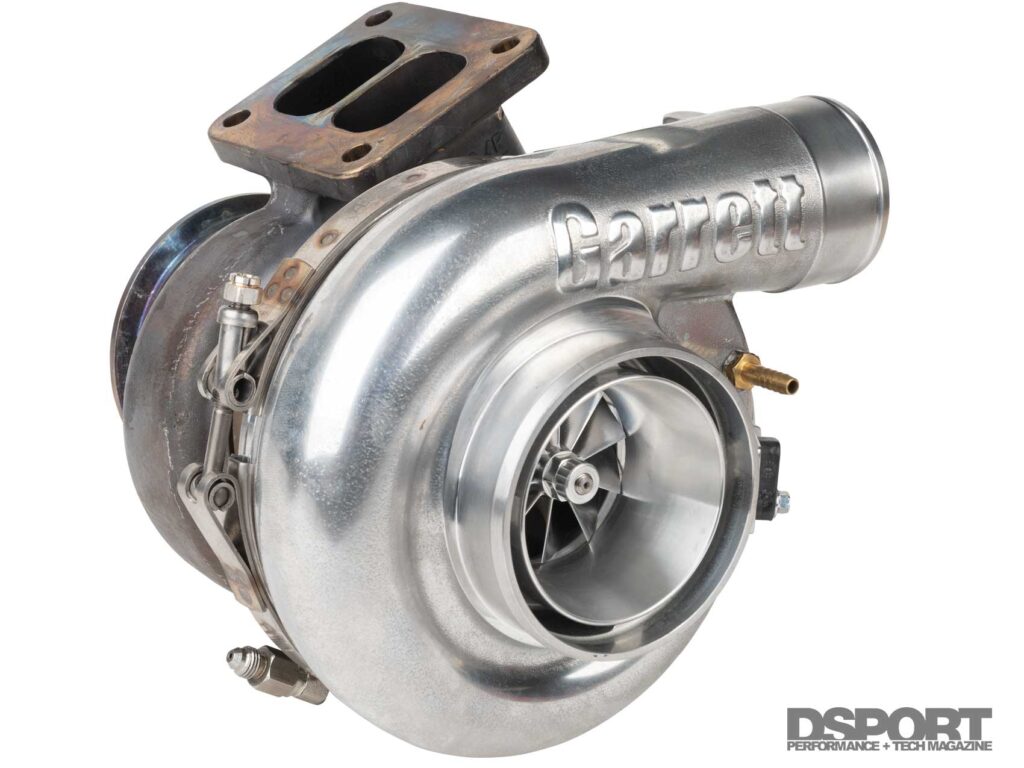
The Garrett Motion G40-900 has become a very popular option for applications seeking great response and power on inline-6-cylinder applications like Nissan RB-series, Toyota’s JZ series and some BMW inline sixes. The G40-900 features dual ceramic ball bearings with steel cages (GTX series had polymer cages) for maximum transient response and extreme durability. An aluminum backplate helps cut down on overall weight. The turbo is designed to have water cooling fed through the center section (dual -6AN fittings included) to extend turbo life and eliminate oil coking (to keep our test as fair as possible we ran our turbo without water cooling). If you have an application where water cooling of the center section is not able to be accomplished, be sure to use high-quality engine oils, allow the engine/turbo to cool down after passes and make more frequent oil changes.
On the hot side of the turbocharger, Garrett Motion employs a G40 turbine wheel that features a 77mm inducer and a 70mm exducer (82.6-trim ratio). The aerodynamics of the G40 turbine wheel flow about 15 percent more than the similar sized GTX-series turbine wheels (GTX4088). On the compressor side, the G40-900 uses a compressor housing that also has a 100mm inlet and 70mm outlet. The machined billet compressor wheel features the latest G-series aero with a 62mm inducer on an 88mm exducer for a 49.6-trim ratio. As previously mentioned, the compressor map shows a peak efficiency of 80 percent occurring at 14.5psi when the flow rate is in the 45lb/min mark. Compared to the previous-generation GTX turbos, the G-series turbo flows up to 35 percent more. While the “900” designation is an indication of the potential peak horsepower output that the turbo can support, the G40-900 is best suited for applications in that 600-750whp range.
The Engine: Club DSPORT RB2786cc
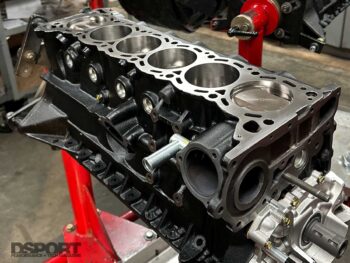
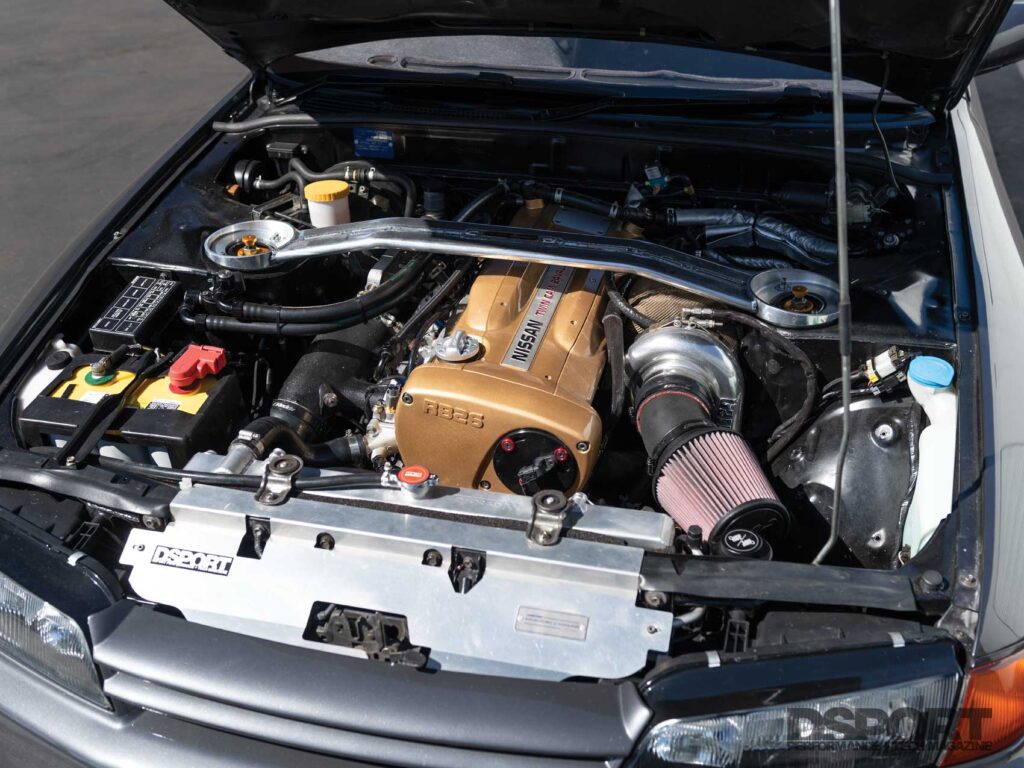
When planning to make 550+whp on pump gas with an RB26-based engine, a properly built and engineered RB engine combination was a must. We decided to use one of Club DSPORT’s most popular engine combinations for the testing. The engine was built on a standard “05U” base block that underwent an intensive cleaning and deburring process before being sonic tested and then CNC-probed in the four-axis CNC center. The extensive probing process located the rail-to-deck-to-crankshaft relationship, the location of the cylinders, the location of the head studs and the location of the head-to-block dowels. This data was fed into the Club DSPORT algorithm to establish the new cylinder locations. The cylinder locations used offset boring and blueprint alignments to locate the cylinders so that the cylinder-to-cylinder bore spacing was exact while also maximizing the cylinder wall thickness. Additionally, the cylinders were also located to improve the mechanical advantage on the power stroke for increased power and reduced friction and wear. Before leaving the 4-axis CNC, the engine block was parallel decked to the crankshaft (primary) and pan rails (secondary) before a chamfer of the cylinders at the deck service and final probing session were conducted. Since the engine block had not been machined before, the final bored size of the cylinders would be 86.4mm, leaving adequate material for the final honing of the cylinders to final size 86.5mm. For higher horsepower applications, the deck surface of the block can be machined for O-rings (over 850whp applications) while in the 4-axis CNC.
Once out of the 4-axis CNC, the 05U engine block only needed to have the cylinders receive final honing. A custom Club DSPORT torque plate along with the same brand of head gasket (A’PEXi in this case) and head studs (ARP CA625+) were torqued into place before a proprietary cylinder honing process was executed that left all cylinders within 0.0002” of target size with less than that figure in taper or out-of-roundness. The finish of all cylinders was also measured with a Mitutoyo SJ-210 profilometer to deliver the designed RvK, Rk and RpK values. These values represented the amount of oil retention, bearing surface and peak roughness in the cylinder before break-in. The optimized finish led to fast engine break-in, superior ring sealing and minimal oil consumption.
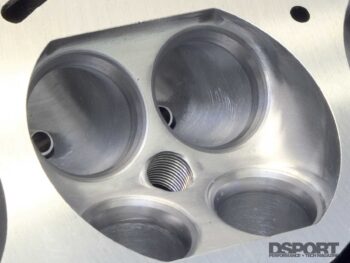
On the cylinder head, the original head was stripped down. Once clean, the cylinder head underwent a hardness test and test spin of the camshafts before heading over to the 4-axis CNC machine center for some work. If the head failed the hardness test or the cams failed to spin easily, a new core would need to be sourced before proceeding.
Once on the CNC, the intake runners were CNC-ported for a perfect match to the intake gasket (also able to do the Plazmaman larger intake runner on CNC). The exhaust runners were CNC-ported to the aftermarket HKS or TOMEI steel gaskets while also getting the unique Max-V D-shape for maximum flow and velocity. The lifter bores were also CNC-modified to allow for high-lift camshafts. Once out of the 4-axis CNC, the cylinder head made its first stop on the Newen for a “pre-valve” job. The “pre-valve” job varies based on the size of the intake and exhaust valves that will be used and the degree of porting that the cylinder head will undergo. Essentially the “pre-valve” job cuts just about all the valve job with the exception of the seat itself. The throats are cut to final size while the chamber undergoes its unshrouding.
After this process is complete, the head is then quickly cleaned before the valve guides are removed before porting. All Club DSPORT porting focuses on obtaining peak flow without killing flow velocity. Hence, the overall port size isn’t dramatically changed, but instead the shape of the port is optimized. For this application, the owner opted for +1mm intake and +1mm exhaust valves from Supertech, which requires a “full port” to optimize the cylinder head for the larger valves.
Upon completion of the hand porting process, the head then received new guides that were diamond-honed to proper clearance with the new valves. Once this clearance was set, the cylinder head made a return to the Newen for its final valve job that features multi-angles and full-radius segments to provide the best flow performance at low lifts, while maintaining generous contact widths for long life. Once the CNC valve job was completed on the Newen, the cylinder head and its components were washed again before assembly. In this case, a “shimless” setup was selected with Supertech springs and retainers and Club DSPORT shimless buckets, so the valves were “tipped” to the proper overall length to deliver the proper lash setting. On this application, a set of TOMEI USA 282-10.8 camshafts were used. For years, the majority of Club DSPORT RB engine builds have used TOMEI USA camshafts with exceptional results.
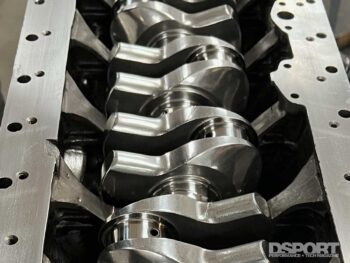
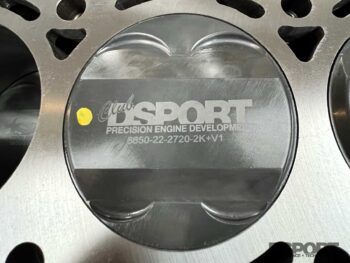
Assembly of the engine included many of the procedures used in F1 and IndyCar engine assembly as the Club DSPORT machine and assembly staff was trained by former F1 and IndyCar engine assembly experts that worked at Cosworth Engineering for over 25 years. The parts used in this assembly included the Club DSPORT’s RB285 stroker kit, which included a 79mm 4340 billet crankshaft by Callies, 4340 connecting rods with ARP CA625+ rods by Manley and custom Club DSPORT-spec 2618-alloy pistons, rings and pins by Mahle. The 86.5mm bore and 79mm stroke deliver a 2,786cc, about 45 more cc than the popular 77.7mm stroker kits. The rotating assembly is rated to 1600whp and 10,000RPM. Above 850whp, an upgrade to a 24U or RRR engine block is recommended.
The beauty of the CDS RB2786 engine package is that it doesn’t lose the original character of the OEM RB26, but simply enhances it. The OEM RB26 achieves peak torque at 4,400RPM and peak horsepower at 6,800RPM with a redline at 8,000RPM. This gives it a span of 2,400RPM between peak torque and peak horsepower, and a span of 3,600RPM between peak torque and redline. In comparison the CDS RB2786 reaches peak torque at 5,100RPM and peak horsepower at 7,900RPM with a redline of 8,700RPM. This gives it a span of 2,800RPM between peak torque and peak horsepower (16.7% improvement), and an identical span of 3,600RPM between peak torque and redline. Of course, the improved breathing of the CDS RB2786 results in much more usable torque and power between peak horsepower and redline.
Club DSPORT (CDS) RB2786cc
Block: Nissan RB26 05U
Bore & Stroke: 86.5mm x 79.0mm
Displacement: 2,786cc
Crank: 4340 Billet, Full Counterweight by Callies
Pistons: CDS 2618-alloy, Gas-Ported, Anodized Top
Groove, Grafal Skirt Coating, Phosphate
Coating, Deep Valve Pockets, Offset Pin
Internal Milling, Accumulator Groove, 8.9:1
Pins 22mm H13 tool steel 0.250” wall, WPC treated
Rods: 121.50mm 4340 Forged I-beam w/CA625+
Main Fasteners: ARP2000 Main Stud Kit
Balance: 3-stage to less than 0.25g total dynamic
Head Fasteners: ARP CA625+ w/modified washers
Cylinder Head: NISSAN RB26 05U 2
Intake Ports: CDS 4-axis CNC match port
Intake Porting: Hand Blended & Optimized for +1mm valves
Exhaust Ports: CDS 4-axis CNC match port w/D-port
Exhaust Porting: Hand Blended & Optimized for +1mm valves
Valves: Supertech +1mm SS Int / +1mm Inconel Ex
Guides: Supertech Bronze Alloy
Spring/Retainers: Supertech Dual Spring kit w/ Ti Retainers
Cam Followers/Shims: CDS 31mm SHIMLESS w/WPC treatment
Camshafts: TOMEI USA 282-10.8mm PROCAMS
Crank/Cam Trigger: HKS
Oil Pump: HKS
Modified Sump: Yes, Extended Capacity
Front Differential: Cusco LSD w/4-spider Gears and O/S Clutches
Power Handling: 850whp w/05U block, up to 1,600whp
with 24U block
Engine Redline 8,700RPM (based on current cam selection)
RPM@Peak HP 7,900 RPM on 91 octane
RPM@Peak TRQ 5,100RPM on 91 octane
The Test
Apples to apples! The main focus of the design of this test was to keep the number of variables to a minimum while making the test as fair as possible in comparing technology against size. The same engine, turbo kit, wastegate, wastegate spring, intake and downpipe were used for all the tests. All tests were run on the same 91 octane pump gas obtained from the same pump. Boost levels were matched to less than 2% difference with the boost being within 0.25~0.50psi in most cases. The choke area of the two turbos was nearly identical too. The GReddy T78-33D used a turbine housing with a 17cm2 choke area. The 0.95A/R of the divided inlet T4 turbine housing used on the G40-900 for the testing had a very similar 16.85cm2 choke area. All tests were conducted on the same Club DSPORT DynoJet 424xLC Linx chassis dyno. All tuning was done by Michael Ferrara on the AEM 5-series ECU. No changes were made to the timing or fuel tables during the testing.
The Results
We were skeptical that our latest-technology Garrett Motion G-series turbo could outperform a 12.6% larger (in terms of inducer area) GReddy T78-33D that served as a benchmark for so many years (you can still buy the kit from Japan with this same turbo today!). While technological upgrades like the dual ceramic ball bearings show improvements in transient response, it doesn’t show up on a chassis dyno test. Instead, it would all come down to the improvements in aerodynamics between the compressor and turbo wheels that were designed about 30 years apart from each other.
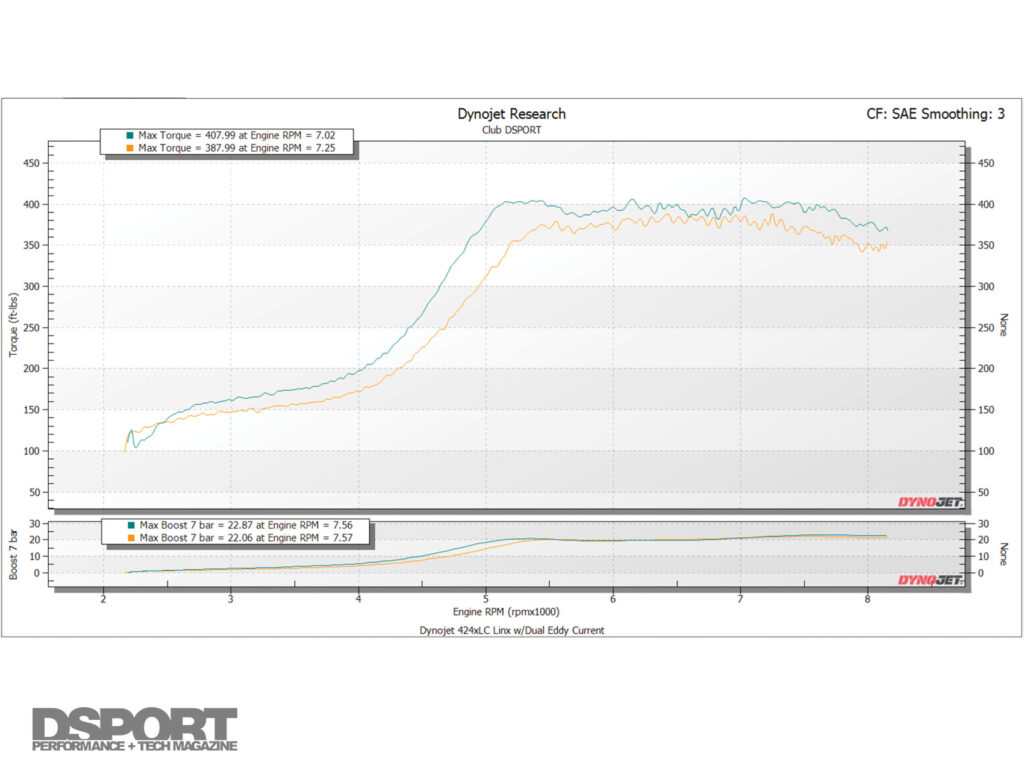
With regard to response, we expected that the “smaller” inducer and exducer of the Garrrett Motion G40-900’s compressor would be able to make boost earlier than the GReddy T78-33D. All other factors being equal (there are a number of factors not equal comparing turbos engineerd 30 years apart from each other), a smaller turbo will have better response than a bigger turbo. However, we wondered how the larger turbine wheel of the Garrett G-series would respond as it was about 5-percent larger in area on the inducer side and nearly 16% larger on the exducer side. Whereas the GReddy T78-33D was able to reach its boost target at 5,500RPM, the Garrett Motion G40-900 was able to reach it 600RPM earlier at 4,900RPM. As expected, the newer technology and slightly smaller Garrett Motion G40-900 G-series turbo showed a significant increase in boost response.
Testing Highlights
• Smaller 62mm Garrett Motion turbo outperformed the larger 66mm MHI turbo in terms of response, efficiency and power
• Extreme response increase: G40-900 turbo reached target boost 600RPM sooner (4,900RPM vs. 5,500RPM)
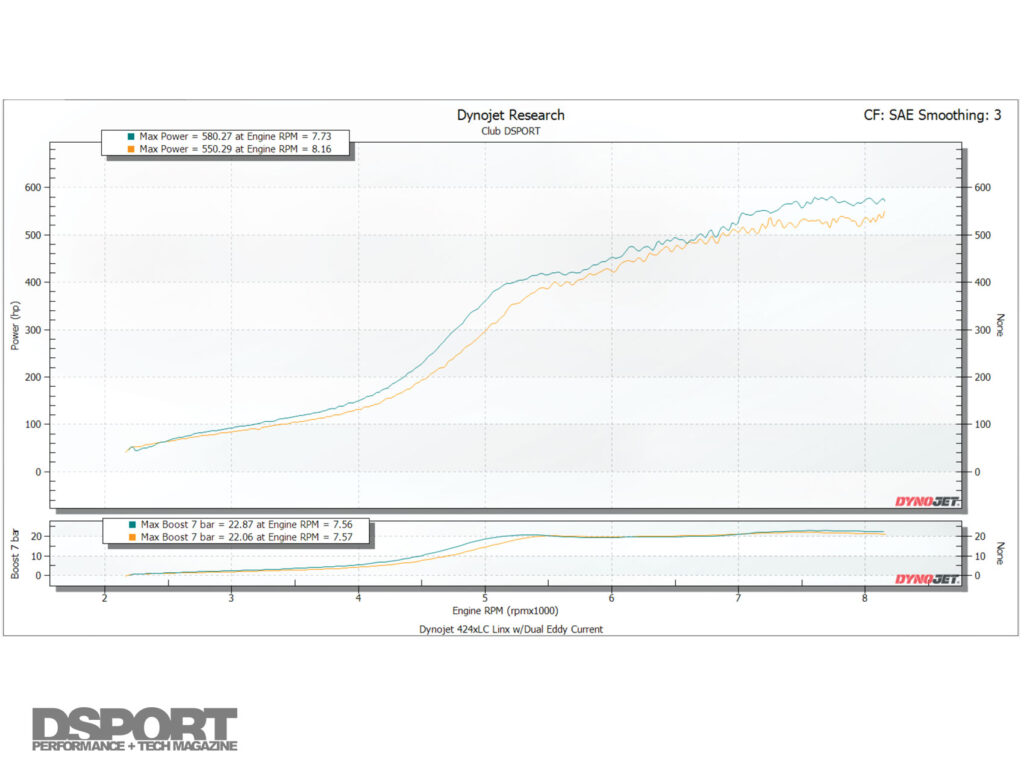
• Significant Efficiency/Power Increase: G40-900 turbo made up to 21% more power and torque at the same boost level
While few would doubt that the G-series would better the venerable MHI turbo in response, finding people that would believe the smaller 62mm turbo could make more horsepower is much more difficult. It’s the equivalent of taking a 200-pound Olympian from 30 years ago and putting them up against a 175-pound Olympian of today. Of course, you would expect today’s 175-pound Olympian to be quicker, but you wouldn’t expect the smaller Olympian to be able to better the 200-pound Olympian in a power lifting contest. During our testing, that is exactly what the G-series turbo did.
| 22psi Boost Level on 91-octane Pump Gas | ||||||||
|---|---|---|---|---|---|---|---|---|
| T78-33D Turbo | G40-900 Turbo | Performance Difference | ||||||
| RPM | Power | Torque | Power | Torque | Power+ | %Power | Torque | %Torque |
| 2500 | 64.18 | 134.95 | 65.84 | 138.39 | 1.66 | 2.6% | 3.44 | 2.5% |
| 3000 | 84.30 | 147.49 | 92.51 | 162.01 | 8.21 | 9.7% | 14.52 | 9.8% |
| 3500 | 104.30 | 156.56 | 116.41 | 174.70 | 12.11 | 11.6% | 18.14 | 11.6% |
| 4000 | 131.43 | 172.61 | 150.05 | 196.99 | 18.62 | 14.2% | 24.38 | 14.1% |
| 4500 | 193.27 | 225.41 | 229.30 | 267.59 | 36.03 | 18.6% | 42.18 | 18.7% |
| 5000 | 297.87 | 312.81 | 362.06 | 379.91 | 64.19 | 21.5% | 67.10 | 21.5% |
| 5500 | 390.13 | 372.61 | 417.29 | 398.42 | 27.16 | 7.0% | 25.81 | 6.9% |
| 6000 | 424.16 | 371.12 | 451.42 | 394.94 | 27.26 | 6.4% | 23.82 | 6.4% |
| 6500 | 472.08 | 381.49 | 492.26 | 397.47 | 20.18 | 4.3% | 15.98 | 4.2% |
| 7000 | 509.80 | 382.63 | 532.22 | 399.31 | 22.42 | 4.4% | 16.68 | 4.4% |
| 7500 | 530.35 | 371.51 | 560.71 | 392.58 | 30.36 | 5.7% | 21.07 | 5.7% |
| 8000 | 534.13 | 350.67 | 573.60 | 376.56 | 39.47 | 7.4% | 25.89 | 7.4% |
| Peak | 550.29 | 386.74 | 578.30 | 405.81 | 28.01 | 5.1% | 19.07 | 4.9% |
In test after test, the Garrett Motion G40-900 bested the GReddy T78-33D turbo with the boost set at the same level (18psi or 22psi). Despite being 11.2 percent smaller, the Garrett Motion G40-900 delivered up to 16 percent more peak power and up to 12 percent more peak torque at the same boost levels. The biggest gains in torque and horsepower were found at mid-range engine speeds thanks to the superior boost curve of the G40-900. At 5,000RPM, the G40-900 delivered an extra 63ft-lbs of torque and an extra 60 horsepower with the boost set to 18psi. At 22psi, the improvements were even better with an additional 67ft-lbs of torque and an extra 64 horsepower. One cool feature with the dyno’s WinPep 8 software is it allows us to calculate the area under the curve change on the horsepower versus engine speed graphs. The difference was a solid 8.0-percent increase. In looking at the response versus time, the G40-900 reached full boost in just 85% of the time it took the T78-33D turbo.
| Turbo Specifications | |||||
|---|---|---|---|---|---|
| Bigger with Older Tech | Smaller with Newer Tech | Smaller with Newer Tech | |||
| Turbo Name | Greddy T78-33D-17cm2, Twin-Scroll T4 | Garrett Motion G40-900 | Garrett Motion G35-900 | ||
| Manufacturer | Garrett Motion | Garrett Motion | |||
| Release Date | 1991 | 2017 | |||
| Part Numbers | 11500260 | 860777-5003S (super core) | |||
| 757707-0033 (turbine housing) | |||||
| Bearing Type | Large Journal Bearing | Dual Ceramic Ball Bearing with Steel Cage | Dual Ceramic Ball Bearing with Steel Cage | ||
| Bearing Housing | Oil Cooled | Oil +Water Cooled | Oil +Water Cooled | ||
| Comp. Inlet | 100mm | 100mm | 100mm | ||
| Comp. Outlet | 70mm | 70mm | 70mm | ||
| Comp Wheel | 65.8mm inducer / 90mm exducer | 62.0mm inducer / 88mm exducer | 62.0mm inducer / 88mm exducer | ||
| Inducer Area | 34.0cm2 | 30.2cm2 | 30.2cm2 | ||
| Exducer Area | 63.6cm2 | 60.8cm2 | 60.8cm2 | ||
| Comp Trim Ratio | 53.4-trim | 49.6-trim | 49.6-trim | ||
| Turbine Inlet | T4 Divided | T4 Divided | T4 Divided | ||
| Turbine Wheel | 74mm inducer / 64mm exducer | 77mm inducer / 70mm exducer | 68mm inducer / 62m exducer | ||
| Inducer Area | 43.0cm2 | 46.6cm2 | 36.3cm2 | ||
| Exducer Area | 33.2cm2 | 38.5cm2 | 32.2cm2 | ||
| CIA/TEA Ratio | 1.024 | 0.784 | 0.938 | ||
| CIR/TER Ratio | 1.028 | 0.886 | 1.000 | ||
| Turbine Trim | 77.1-trim | 82.6-trim | |||
| Turbine Housing | 17cm2 | 0.95A/R (16.85cm2) | 1.06A/R (only T4 Divided Option) | ||
| Optional Housings | 0.85A/R, 1.06A/R, 1.19A/R (All Divided T4) | ||||
| MAX RPM | 122,250RPM | 145,000RPM | |||
| MSRP | $2,670.00 | $3,259.52 | |||
Future Testing
In this first round of testing, we decided to use 91-octane California fuel. This provided the worst-case scenario for those running premium fuel around the country. Despite this limitation, the Club DSPORT-built 2.8-liter RB26 engine equipped with the Garrett Motion G40-900 sent 578 horsepower to the ground with ease (equivalent to about 680 horsepower at the flywheel).
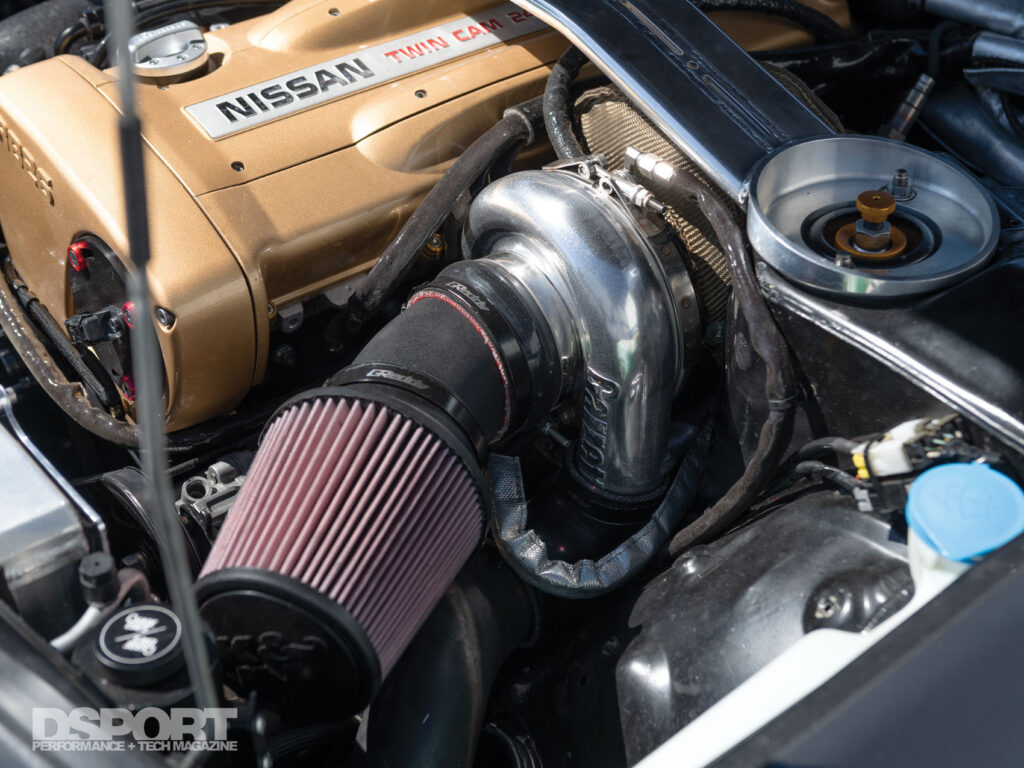
Since we already have the necessary fuel pump and injector combination to support E85 and higher power levels, we plan to do some tuning on E85 and compare the turbos again at the higher boost levels possible with the E85 fuel. Looking back at earlier tests with the T78-33D turbo on 91 octane versus E85, it appeared that the E85 tune actually allowed the turbo to reach its boost target about 200-250RPM sooner than on 91 octane. We also found that an additional 3.5-4psi of boost pressure with the more aggressive timing curve let us find an extra 100 horsepower before. Extrapolating the data we have on hand, we expect to realize 690-750whp on E85 in our next round of testing of the G40-900 at a peak boost pressure of about 23-24psi at peak torque RPM and 28-29psi near peak power RPM. Stay tuned.